
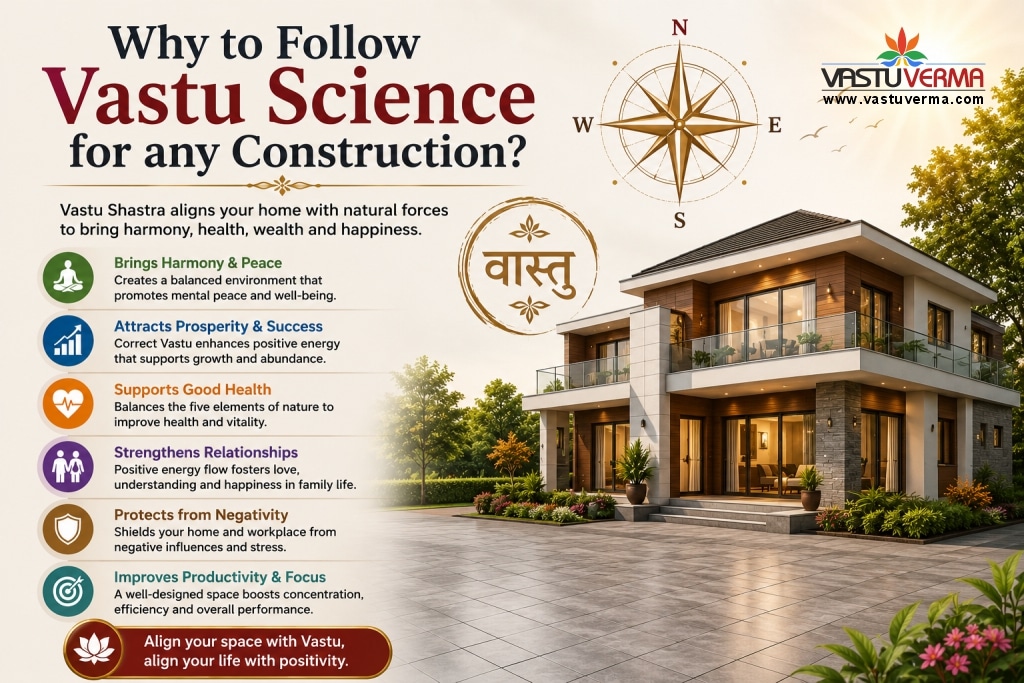
Construction is not only the process of creating walls, rooms, doors, and roofs. It is the creation of a long-term environment in which people will live, work, communicate, make decisions, conduct business, rest, and grow. This is why planning a building only according to appearance or available space may not always be sufficient.
Vastu Shastra for construction is a traditional Indian system of architectural and spatial planning. It studies the relationship between a structure, its orientation, natural forces, the five elements, and the activities performed in different areas.
The primary purpose of Vastu is to create a balanced environment in which space, movement, light, ventilation, functionality, and directional planning work together. When considered before construction begins, its principles can often be integrated more efficiently than after a building has already been completed.
What Is Vastu Shastra?
Vastu Shastra is a traditional body of knowledge related to architecture, site planning, building orientation, spatial organization, proportions, entrances, open spaces, and the placement of different activities within a structure.
The word Vastu broadly refers to a dwelling, site, building, or habitable space. Shastra refers to an organized system of knowledge or principles.
Vastu does not examine a room in isolation. It studies the complete relationship among:
- The plot
- Building orientation
- Main entrance
- Centre of the building
- Open and constructed areas
- Distribution of rooms
- Movement routes
- Natural light
- Ventilation
- Water arrangements
- Fire-related activities
- Storage
- Structural weight
- Human activities
- Surrounding roads and neighbouring structures
The purpose is to create coordination between the built environment and the natural environment.
Why Is Vastu Important in Construction?
A building remains in use for many years. A planning mistake made during the design stage can affect movement, convenience, ventilation, privacy, safety, maintenance, and functional efficiency throughout the life of the property.
Vastu planning encourages the owner and architect to consider not only how a building will look, but also how it will function.
For example, before construction begins, the following questions should be studied:
- Is the main entrance appropriately located?
- Does the internal circulation feel natural?
- Are heavy and light areas properly distributed?
- Is sufficient natural light available?
- Are wet areas functionally planned?
- Is the kitchen positioned safely and practically?
- Are bedrooms placed according to user requirements?
- Are work areas conducive to focus and productivity?
- Is the central portion overcrowded?
- Are services creating avoidable conflicts?
- Are open spaces distributed sensibly?
These questions are relevant both from a Vastu perspective and from practical architectural planning.
Vastu and the Forces of Nature
The supplied concept describes Vastu as a system connected with natural forces and their directional effects. Traditional Vastu interpretation considers a building to be continuously interacting with its surrounding environment.
The major environmental influences include:
- Sunlight
- Heat
- Air circulation
- Earth
- Water
- Seasonal changes
- Magnetic orientation
- Local climate
- Topography
- Surrounding structures
Vastu aims to organize a building so that these forces are used constructively rather than obstructed unnecessarily.
For instance, sunlight can support illumination and hygiene when properly controlled. Excessive heat, however, can reduce comfort. Air circulation may improve indoor conditions, but poorly planned openings can create glare, dust, noise, or privacy problems.
Therefore, balance is more important than blindly maximizing any one natural influence.
Latest blog

Vastu for Home Entrance: Expert Guidelines for a Positive and Balanced Home
Why Vastu Planning Matters Before Construction ?
Jul
Why Vastu Planning Matters Before Construction ?
Why Vastu Planning Matters Before Construction ?
Jul

Vastu Devta : Mitra Devta: Vedic Deity of Harmony, Cosmic Binding and Vastu Energy
Mitra Devta: Vedic Deity of Harmony, Cosmic Binding and Vastu Energy
May


Brahma – Brahmasthan in Vastu : Meaning, Importance and Guidelines
Brahma - Brahmasthan in Vastu : Meaning, Importance and Guidelines
Mar