
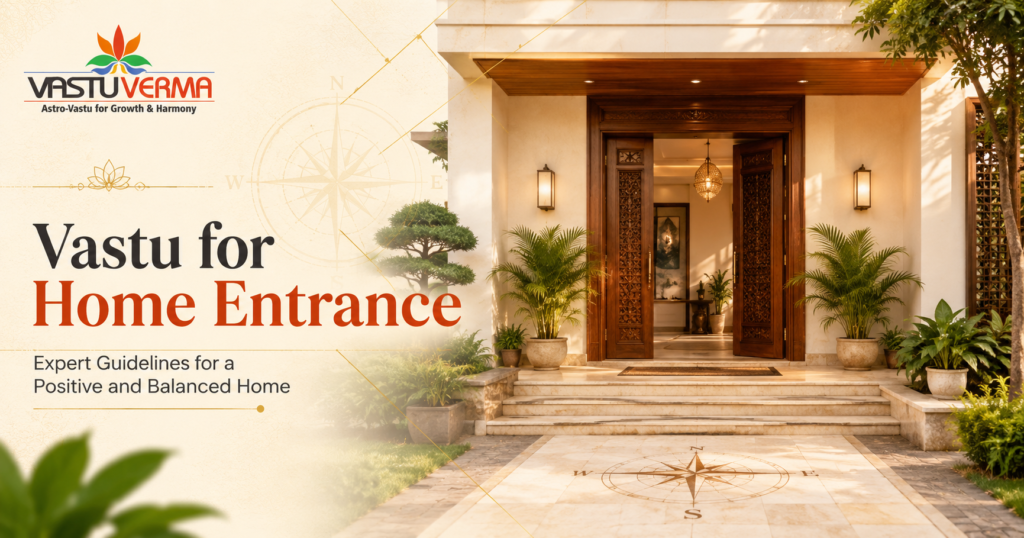
The main entrance of a house is much more than a doorway. It creates the first impression of the property, controls movement into the home, and is traditionally regarded in Vastu Shastra as the primary channel through which external energies enter the building.
For this reason, Vastu for the home entrance is considered one of the most important parts of residential planning. Although room placement, colours, open areas, water arrangements, floor levels, and internal circulation also influence a house, the exact position and condition of the main entrance can have a major impact on the overall Vastu balance.
However, the entrance should never be judged only by its broad direction. Its exact location within that direction, known as the entrance pada or energy field, must also be examined along with the complete floor plan.
Why Is the Main Entrance Important in Vastu?
The entrance connects the outer environment with the inner living space. Every person, opportunity, activity, and movement enters the house through this point.
A properly planned entrance may support:
- Smooth movement and accessibility
- A welcoming atmosphere
- Natural light and ventilation
- Better functional circulation
- A sense of security and stability
- Positive psychological impressions
- Traditional Vastu balance
An improperly planned or obstructed entrance may create practical concerns such as congestion, poor lighting, lack of privacy, unsafe access, or inconvenient internal movement.
In traditional Vastu interpretation, different entrance locations are also associated with different behavioural, financial, health, and relationship patterns. Such interpretations should be considered together with the complete layout rather than used as isolated predictions.
Is the Entrance Direction Alone Enough?
No. Simply saying that an east-, north-, west-, or south-facing entrance is good or bad is an incomplete approach.
Every principal direction contains several smaller energy fields. Two entrances facing the same broad direction can produce very different results because their exact positions may differ.
A professional entrance analysis should examine:
- Exact compass degree
- Directional pada or energy field
- Plot orientation
- Road position
- Entrance level
- Door size and proportion
- Internal movement after entering
- Open and constructed areas
- Staircase position
- Water and fire placements
- Toilets near the entrance
- Extensions and cuts
- Surrounding structures
- Occupants’ requirements
Therefore, a house should not be selected or rejected only because it is north-, east-, south-, or west-facing.
South-West-Facing Home Entrance
Traditional Vastu generally treats the South-West entrance with caution because the South-West direction is associated with stability, control, maturity, permanence, and structural weight.
When the main entrance occupies an unsuitable South-West pada, traditional practitioners may associate it with:
- Instability in major decisions
- Unplanned expenditure
- Relationship pressure
- Lack of control over household matters
- Obstacles in retaining money
- Emotional or professional insecurity
- Repeated changes or setbacks
South-East-Facing Home Entrance
The South-East is associated with the fire element, electrical activity, transformation, heat, and intensity.
An incorrectly positioned South-East entrance is traditionally associated with:
- Anger and impatience
- Frequent arguments
- Increased stress
- Excessive expenditure
- Legal or administrative disputes
- Fire or electrical concerns
- Health discomfort linked with heat or inflammation
These are traditional interpretations and should not be understood as guaranteed outcomes. Family behaviour, financial circumstances, construction quality, ventilation, electrical safety, and many other factors also influence such conditions.
West-Facing Home Entrance
A west-facing entrance is not automatically negative. Certain western entrance padas are traditionally associated with:
- Activity and movement
- Achievement through effort
- Social interaction
- Gains and opportunities
- Enjoyment and satisfaction
- Ambition among younger family members
A properly located west entrance may support active households, professionals, businesspeople, and people whose work requires networking or public interaction.
However, other western padas may be associated with delays, emotional dissatisfaction, dependency, poor savings, or repeated effort without proportionate results.
North-West-Facing Home Entrance
The North-West direction is traditionally connected with movement, communication, networking, support systems, travel, change, and social interaction.
A correctly placed North-West entrance may be associated with:
- Helpful contacts
- Business movement
- Social opportunities
- Travel
- Faster communication
- Support from external sources
- Active professional life
At the same time, excessive North-West activation may create instability or frequent movement.
North-Facing Home Entrance
North is commonly associated with financial opportunities, communication, commercial activity, career movement, and growth.
A correctly placed north-facing entrance may traditionally support:
- Business opportunities
- Financial movement
- Professional networking
- Client inflow
- Communication
- Career development
However, a north-facing entrance is not automatically auspicious. Its result depends on:
- Exact northern pada
- Underground water placement
- North-side openness
- Floor slope
- Extensions or cuts
- Toilet location
- Staircase or heavy storage
- Internal room arrangement
A blocked, excessively elevated, damaged, or poorly maintained north entrance may not provide the expected benefits.
North-East-Facing Home Entrance
The North-East is traditionally associated with clarity, wisdom, spiritual inclination, openness, purity, and fresh beginnings.
A properly designed North-East entrance may support:
- Mental clarity
- Peaceful atmosphere
- Learning
- Spiritual interest
- Better planning
- Positive social interactions
- A welcoming home environment
However, the North-East should not be excessively burdened or disturbed by:
- Heavy storage
- Large electrical installations
- Toilets
- Dark colours
- Clutter
- Broken objects
- Improper drainage
- Excessive structural load
Even a North-East entrance requires precise analysis. Not every doorway placed anywhere in the North-East produces the same result.
East-Facing Home Entrance
East is associated with sunrise, visibility, recognition, vitality, authority, and new opportunities.
A suitable east-facing entrance may traditionally support:
- Social recognition
- Confidence
- Professional visibility
- Leadership
- New opportunities
- Positive beginnings
- Healthy morning light
However, an entrance in an unsuitable eastern energy field may create concerns related to:
- Excessive expectations
- Dominating behaviour
- Delayed recognition
- Confusion in social identity
- Poor coordination with authority figures
Architecturally, morning sunlight can be beneficial, but glare, privacy, rain exposure, and heat should also be managed.
Latest blog

Vastu for Home Entrance: Expert Guidelines for a Positive and Balanced Home
Why Vastu Planning Matters Before Construction ?
Jul

Why Vastu Planning Matters Before Construction ?
Why Vastu Planning Matters Before Construction ?
Jul

Vastu Devta : Mitra Devta: Vedic Deity of Harmony, Cosmic Binding and Vastu Energy
Mitra Devta: Vedic Deity of Harmony, Cosmic Binding and Vastu Energy
May


Brahma – Brahmasthan in Vastu : Meaning, Importance and Guidelines
Brahma - Brahmasthan in Vastu : Meaning, Importance and Guidelines
Mar