
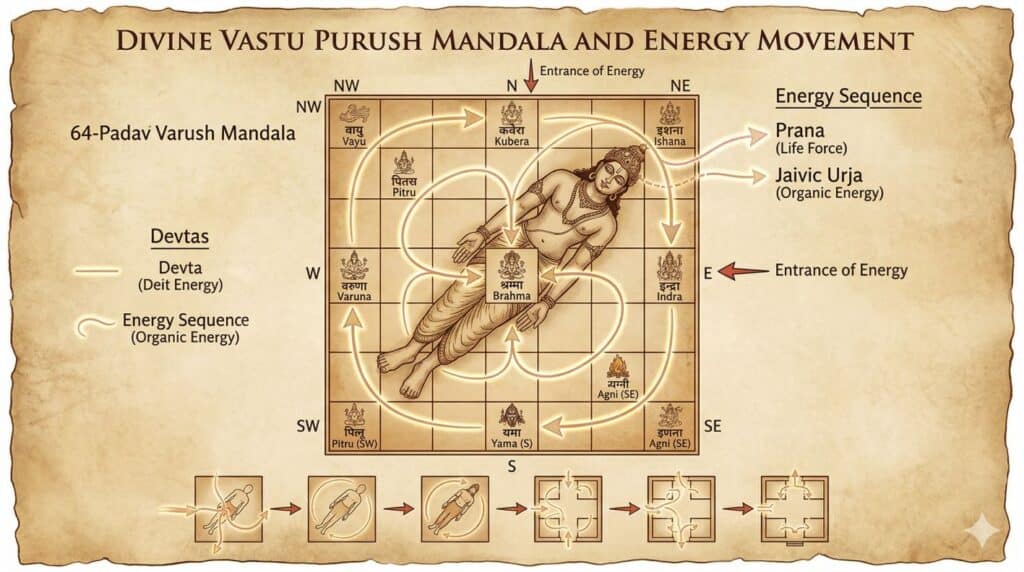
The Living Architecture of the Vastu Purush Mandala
The Vastu Purush Mandala is not merely a geometric diagram but a cosmic blueprint of existence, where space is organized as a conscious field of energies. Each division of the Mandala is governed by a Devta, representing a specific function of universal intelligence. In the classical system, the Mandala is populated by 45 Devtas, each embodying a distinct aspect of creation, preservation, transformation, and interaction.
This system finds its philosophical roots in the Atharvaveda and later elaborations in texts like the Brihat Samhita, where space is understood as a living organism, not an inert container. The Vastu Purush himself represents the cosmic being lying within space, and the Devtas are the functional energies operating through his body.
The 45 Devtas are arranged in layers—outer, intermediate, and inner—each corresponding to different levels of manifestation, from gross physical forces to subtle psychological and spiritual influences. Together, they form a complete ecosystem of life energy, governing everything from health and relationships to success and consciousness.
Structural Logic of the 45 Devta Grid
The Mandala is divided into directional zones, each populated by Devtas who collectively define the nature of that direction. The outer layer primarily governs external interactions and environmental forces, the middle layer controls functional aspects of life, and the inner layer represents core consciousness and stability.
Each Devta is not isolated but functions in interdependent clusters, forming energetic circuits. For example, the Western belt, where Mitra resides, works as a relationship and social harmony circuit, while the South-East zone operates as a fire and transformation circuit.
Understanding this interconnectedness is essential, because a disturbance in one Devta does not remain localized—it affects the entire energetic chain.
Eastern Zone Devtas: Source of Light and Initiation
The Eastern direction represents the entry of solar intelligence, governed by Devtas such as Indra, Surya, and Jayanta. These Devtas collectively regulate new beginnings, vitality, and clarity of purpose.
When this zone is balanced, the occupants experience clarity in decision-making, confidence, and growth opportunities. From an Ayurvedic perspective, this zone influences Pitta balance, governing metabolism and vision. Any disturbance here leads to confusion, lack of direction, and weakened vitality.
South-East Zone: The Fire Circuit
The South-East is dominated by Agni and associated Devtas, forming the transformation and energy conversion system of the Mandala. This zone governs digestion, both physical and mental.
A balanced South-East ensures strong digestion, enthusiasm, and execution power, while imbalance leads to anger, digestive disorders, and erratic energy levels. The Ayurvedic correlation is directly with Agni and Pitta dosha, making this zone critical for overall health.
Southern Zone: Stability, Discipline, and Karma
The Southern belt is governed by Devtas such as Yama and Gandharva, representing discipline, karmic structure, and control. This zone stabilizes life through structure and responsibility.
When balanced, it provides consistency, authority, and grounded action. When disturbed, it creates fear, instability, and lack of discipline. It also affects the musculoskeletal system and endurance from an Ayurvedic perspective.
South-West Zone: Weight, Control, and Security
The South-West is one of the most powerful zones, governed by Devtas like Nirrti, representing control, stability, and long-term security. This is the zone of ownership and command.
A strong South-West ensures authority, financial stability, and emotional grounding. A defect here leads to insecurity, losses, and lack of control in life. Elementally, it is dominated by Earth (Prithvi) and influences structural strength in the body.
Western Zone: Mitra and the Field of Relationships
The Western zone, governed by Mitra and associated Devtas, represents the field of relationships, social interactions, and external support systems. This is where life reflects back the quality of one’s connections.
A balanced West ensures strong partnerships, support from society, and emotional harmony, while imbalance leads to conflicts, isolation, and breakdown of trust. This zone directly influences emotional health and heart energy.
North-West Zone: Movement and Change
The North-West zone is governed by Vayu and related Devtas, representing movement, transition, and communication. It controls the dynamic aspects of life such as travel, networking, and change.
When balanced, it promotes flexibility and growth, but when disturbed, it creates instability, anxiety, and restlessness. It is closely linked with Vata dosha in Ayurveda.
Northern Zone: Wealth and Flow
The North is associated with Kubera and wealth-giving energies, representing flow of resources and opportunities. This zone governs financial growth and career expansion.
A balanced North ensures steady income and opportunities, while imbalance leads to financial blockages and stagnation. It influences fluid balance and circulation in the body.
North-East Zone: Spiritual Core and Purity
The North-East is the most sacred zone, governed by Ishana, representing spiritual connection, intuition, and purity. This is the zone of divine alignment.
When balanced, it enhances wisdom, peace, and clarity, while disturbance leads to confusion, stress, and lack of purpose. It influences the mind and nervous system.
Central Zone (Brahmasthan): The Heart of the Mandala
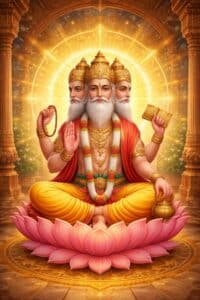
At the center lies Brahma, representing pure consciousness and balance. This zone connects all other zones and must remain open and unobstructed.
A disturbed center leads to overall imbalance in life, as it disrupts the coordination of all Devtas.
Interconnected Functioning of All 45 Devtas
The 45 Devtas do not operate independently; they function as a coordinated network, similar to organs in a body. Each Devta supports and regulates others, creating a dynamic equilibrium.
For example, Mitra’s relational energy depends on Varuna’s ethical grounding and Vayu’s communication flow. Similarly, Agni’s transformation requires proper support from Prithvi (Earth) and Vayu (Air).
Thus, Vastu is not about isolated corrections but about restoring systemic harmony.
Disease Formation Through Devta Imbalance
When a particular Devta is disturbed, it first affects the energy field, then the mind, and finally manifests in the physical body. This progression aligns with Ayurvedic principles.
For instance:
- Fire imbalance → digestive disorders
- Air imbalance → anxiety and nervous issues
- Water imbalance → emotional instability
Thus, each Devta corresponds to a specific health pattern, making Vastu a powerful diagnostic tool.
Principles of Devta-Based Remedies
The correction of Devta imbalance involves:
- Restoring spatial balance (placement, structure)
- Elemental correction (colors, materials)
- Behavioral alignment (thoughts, actions)
True Vastu remedies are not superficial; they are multi-layered corrections that align space, body, and consciousness.
The Mandala as a Living Universe
The 45 Devta system represents a complete model of existence, where every aspect of life is governed by a corresponding energy. Understanding this system allows one to decode life patterns through space.
Each house becomes a microcosm of the universe, and each individual becomes a participant in this cosmic dance.
When all Devtas are balanced, life flows effortlessly. When even one is disturbed, imbalance begins to ripple through all aspects of existence.
Latest blog
Brahma – Brahmasthan in Vastu : Meaning, Importance and Guidelines
Bhujang , The serpent energy
Mar





Harness the Power of the Sword Through Vastu
Harness the Power of the Sword Through Vastu Shastra
Jul